Blog
Lead of the Week: A Free Sample Drop-Off Earns Team Feedback
July 27, 2026 · Angel Roman
Most corporate catering conversations die on a technicality. The buyer wants to say yes but assumes they are too small to qualify.
Situation
A regional restaurant was running AI-powered automated outreach and follow-up through LinkedIn. One message introduced the restaurant and offered three things: office lunch catering, catering for team meetings and events, and free samples for the team.
The prospect replied that they would be open to it. Then came the hesitation. They mentioned a smaller staff, just under 40 people, and asked whether there was a minimum order.
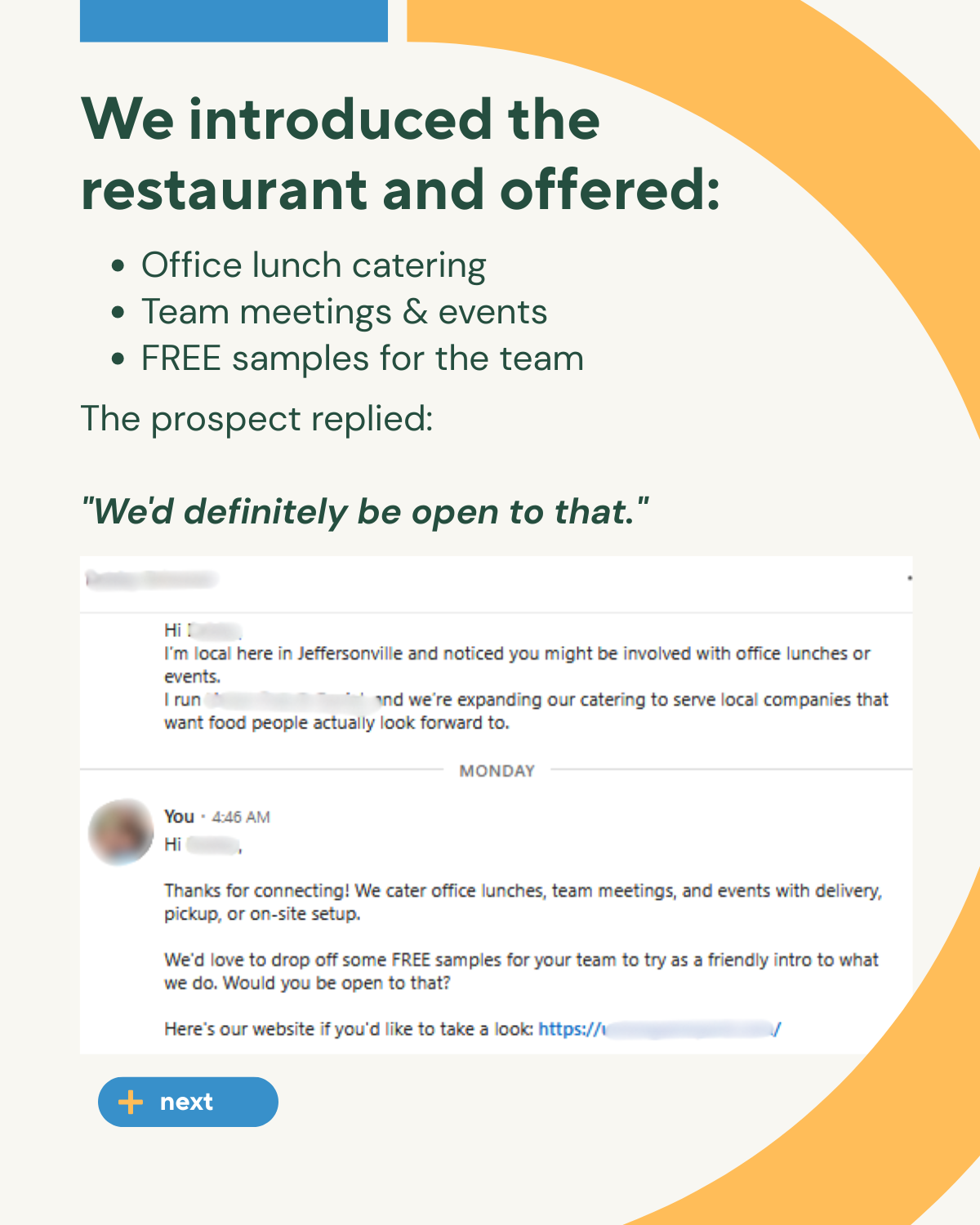
Restaurant: I'm local here in Jeffersonville and noticed you might be involved with office lunches or events. I run [restaurant] and we're expanding our catering to serve local companies that want food people actually look forward to.
Restaurant: Thanks for connecting! We cater office lunches, team meetings, and events with delivery, pickup, or on-site setup.
We'd love to drop off some FREE samples for your team to try as a friendly intro to what we do. Would you be open to that?
Here's our website if you'd like to take a look: [link]
What We Did
That question is a buying signal wearing a rejection costume. The prospect is not saying no. They are asking permission to be a customer.
The restaurant removed the friction in one reply. No minimum order requirement. A link to book the free sample drop-off. The catering menu attached for reference.
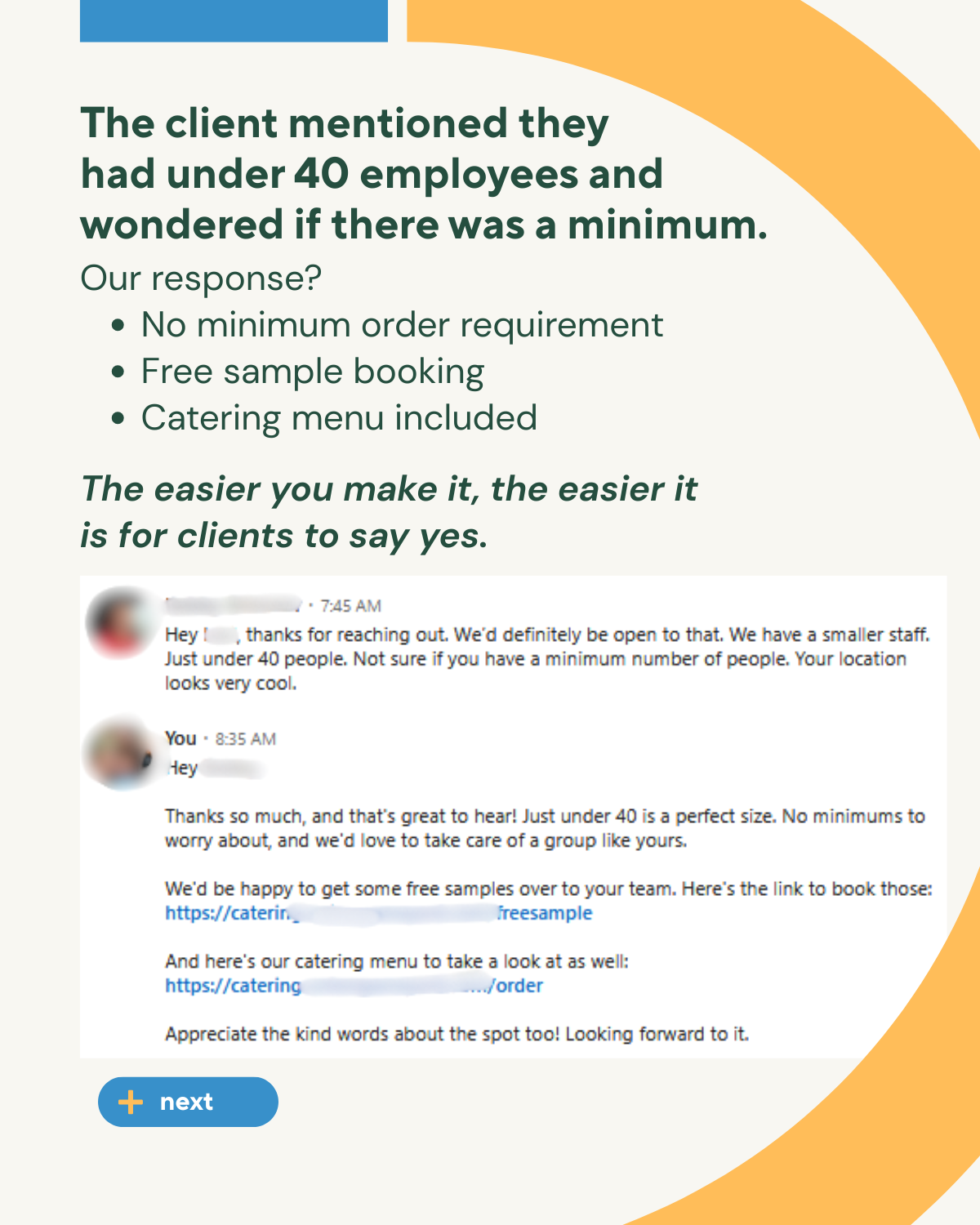
Buyer: Hey [name], thanks for reaching out. We'd definitely be open to that. We have a smaller staff. Just under 40 people. Not sure if you have a minimum number of people. Your location looks very cool.
Restaurant: Thanks so much, and that's great to hear! Just under 40 is a perfect size. No minimums to worry about, and we'd love to take care of a group like yours.
We'd be happy to get some free samples over to your team. Here's the link to book those: [link]
And here's our catering menu to take a look at as well: [link]
Appreciate the kind words about the spot too! Looking forward to it.
Nothing was asked for in return. No quote. No commitment. Just the two things the prospect needed to move forward on their own terms.
The prospect then looped in their office manager, the person who actually coordinates catering. That is the moment a conversation turns into an opportunity. The restaurant was no longer talking to a contact who might forward a menu someday. It was talking to the person who places the orders.
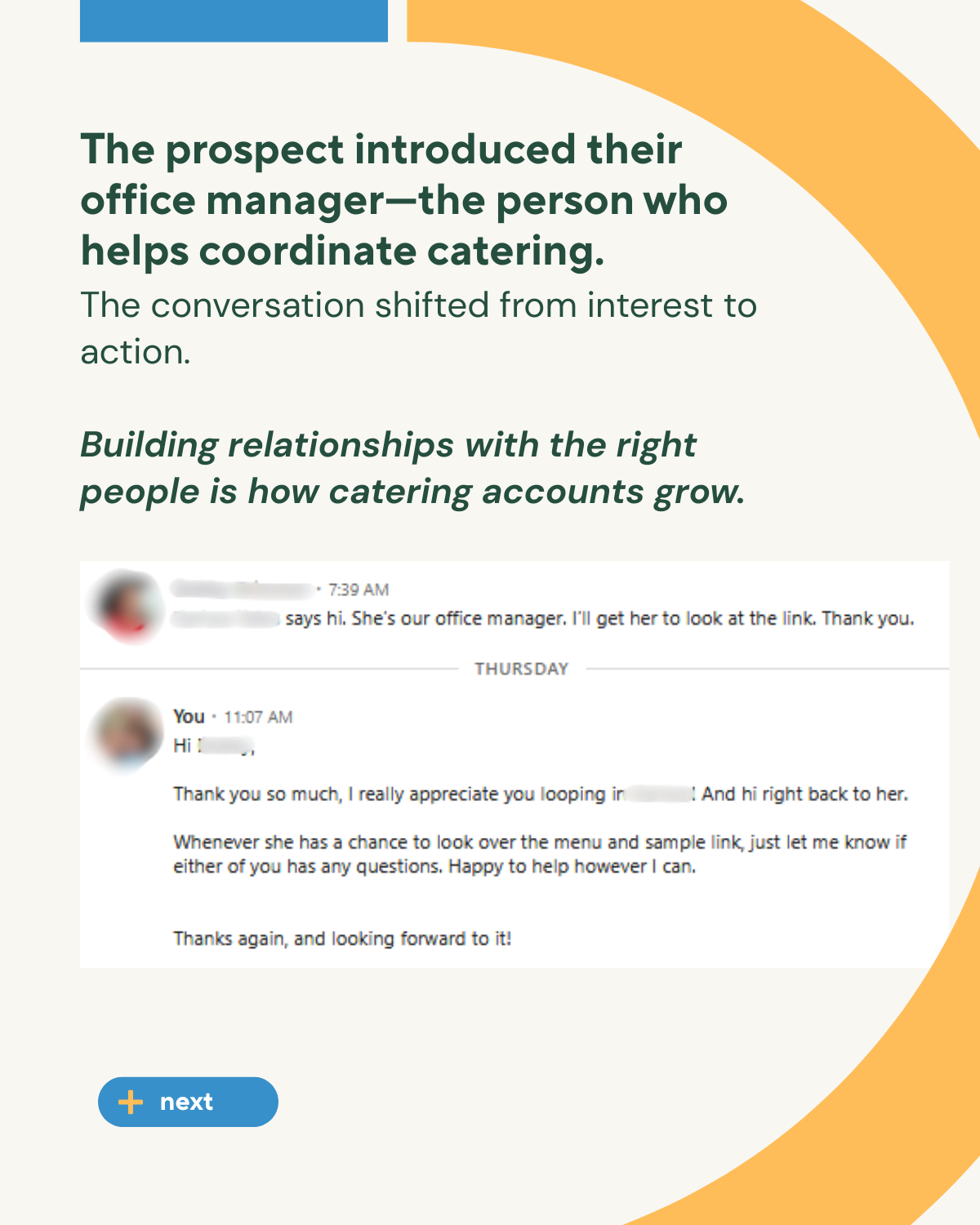
Buyer: [name] says hi. She's our office manager. I'll get her to look at the link. Thank you.
Restaurant: Thank you so much, I really appreciate you looping in [name]! And hi right back to her.
Whenever she has a chance to look over the menu and sample link, just let me know if either of you has any questions. Happy to help however I can.
Thanks again, and looking forward to it!
Result
The samples went out. Afterward, the client reported back that the food was well received and that most of the staff who sampled it gave positive feedback. The office manager would be reviewing pricing for possible future orders.
To be precise about what this is: this post covers the lead. The order is the next step. Future orders are prospective and under review, not earned. There is no revenue figure attached to this win.
What is confirmed is a restaurant that went from unknown to sampled, with the catering decision-maker now engaged and pricing under active review.
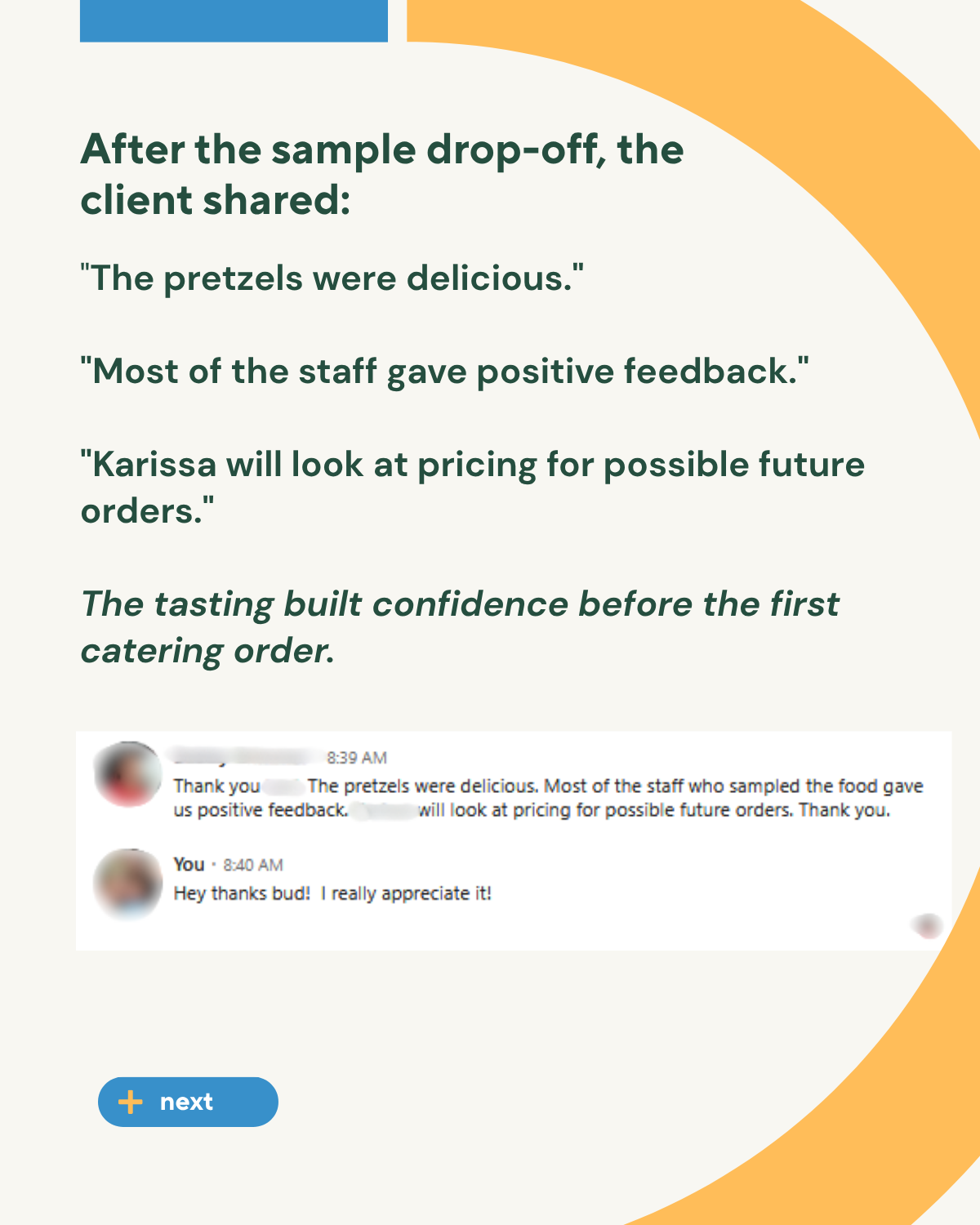
Buyer: Thank you [name]. The pretzels were delicious. Most of the staff who sampled the food gave us positive feedback. [name] will look at pricing for possible future orders. Thank you.
Restaurant: Hey thanks bud! I really appreciate it!
What This Means for Other Operators
Two things opened this door.
The first was removing friction. A minimum order requirement would have ended this conversation before it started. A team of just under 40 people is not too small to be a corporate account. It is a corporate account that orders a little less per event and possibly more often.
The second was letting the food make the first impression. Confidence gets built by tasting, not by reading a PDF. A sample drop also does something a menu never will: it surfaces the real decision-maker, because someone has to coordinate the delivery.
This is how the front end of the corporate catering flywheel is supposed to work. Small yes first. Bigger yes later.
Catering Funnels is a done-for-you lead generation and automation platform built for restaurants with active catering operations. For the full playbook, see the guide to getting corporate catering clients.
For every source of leads and what each costs, see how to get catering leads for your restaurant.
See how this fits the bigger picture in our outreach data from 29,000 corporate catering buyers.
Follow Catering Funnels on LinkedIn for weekly wins and outreach breakdowns from real catering operations.
Want help applying this to your operation?
Book a strategy call.
Book a strategy callNot ready for a call? Get the free Corporate Catering Playbook. No email required.